Your House Achievement & the common law pure trust foundation
Some simply call it your Coat of Arms, some say it’s your Family Crest, or more appropriately what we build, is an Armorial Achievement which is the distinguishing emblem or Flag of your castle that is of your land Jurisdiction that gets formed into a Seal as an official House Embosser for all official “land paperwork” of One’s highest office. It serves as a Public notice that “a land Trust exists“. As a foundational family trust instrument, the common law pure trust foundation is designed to protect all the Family’s real lawful property in trust, on the substantial land jurisdiction – for THOUSANDS of years. Wouldn’t it have been nice if your great, great, great Grandfather put all of the House property into a Family trust for you so all of your family’s equity didn’t get dissipated and plundered by the Governments over the years? Well, going forward, now you can set the Royal trust arrangement up for your House – for generations.
We need to start with the design of your armorial Achievement, the first question to ask is do you want to use your previous family achievement, or start all a new? Depending on the legacy of your family may determine wether or not you want to start all over again or even blend in some elements of your family’s history into your new Family Achievement going forward. If you decide to start a new, we will need to design and approve the final draft before we start on the common law pure trust binder.
It is perfectly legal and lawful for anyone in Canada or the United States to design and/or adopt their own Family’s original Coat of arms or his or her new family choice of Arms. Not only is there is no prohibition against armorial assumption in Canada or the United States, but the sovereign freedom of the Man or Woman to assume their Arms or Crest has also been a time-honored principle carried out in most of the Western world. It is only within a few jurisdictions, particularly England and Scotland, that any laws exist against the assumption of Arms. These laws have not been applicable in Canada or the United States since the attainment of the American independence — supposing they were even applicable in the American colonies before that. Thus, under American law, assumed Arms enjoy the same validity as those granted by the English College of Arms, Scotland’s Lord Lyon, or any other foreign authority.
In some countries, assumed Arms can be legally protected against usurpation by putting them on the public record in some fashion. This is often done by registering them with a recognized heraldic society or even simply by executing a unilateral legal document witnessed and sealed by a notary.
What is an: ‘Armorial Achievement‘?
A family achievement is also known as an Armorial Achievement or Heraldic Achievement (historical: hatchment) in Heraldry there is a full display or depiction of all the heraldic components to which the bearer of a coat of: Arms is entitled. An Achievement comprises not only the coat of: Arms themselves displayed on the Escutcheon, the central element, but also many elements surrounding it as listed below. A Herald is one who gives notice to world-at-large (Public).
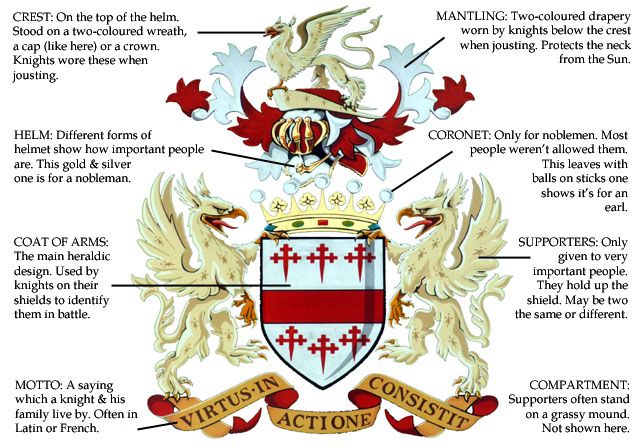 Sometimes the term “Coat of Arms” is used to refer to the full Achievement, but this usage is wrong in the strict sense of heraldic terminology, as a coat of Arms refers to a garment (think of a jacket) with the escutcheon or armorial achievement embroidered on it.
Think of an Achievement as your family’s international flag FOR the foundation that flies atop the Castle walls thusly making a public Proclamation of who & what you and your family stands for. Every Castle needs a flag, so what better flag than a flag with the Foundation’s Achievement. Women use their Fathers Achievement until they are married. The woman’s achievement follows the woman’s Estate lineage, or if Executrix, then said woman and new husband will create a new Achievement together with shields beside one another. Typically the Royals portray a new combination achievement with the woman as a Unicorn supporter on the right with a crown and chain around the neck.
A Crest, not to be confused with ‘Coat of Arms’ is placed on top of:
- Torse (or Cap of Maintenance as a special honour)
- Mantling
- Helm of appropriate variety; if holder of higher rank than a baronet, issuing from a:
- Coronet or Crown (not used by baronets), of appropriate variety.
- Supporters (if the bearer is entitled to them, generally in modern usage not baronets), which may stand on a Compartment)
- Motto, if possessed
- Order, if possessed
- Badge, if possessed
 How to Find Your historical ‘Coat of Arms’
If you have European heritage, you may have a coat of arms or family crest. Unfortunately, they’re rarer than you might think. Most commonly, only nobility or high-class families in medieval Europe had them because they were granted by kings to recognize achievements. Note! Explore the heraldic websites that claim your Family achievement with a grain of salt.
That rarity just makes it all the more exciting if you find one in your family tree. You can search for an Achievement or a Coats of arms associated with your last name using 4crests, Family Search, or other resources. If you find one, trace your family tree to find out if you can find a link or reference to the Achievement or the Coat of arms. While you’re at it, take the opportunity to discover more about your heritage.
Can I start my own new Family Coat of Arms or Achievement?
Yes! You can begin anew if you so desire, the canvas is yours to sculpt and invent from the ground up.
How to Design a Coat of Arms
Designing your own coat of arms can be fun and insightful. Think about your family’s achievements and how you can incorporate them into your design. If you’re looking for inspiration, explore the stories or family pictures your relatives have shared with you for insight into your lineage.

Creating your Family Achievement
A coat of arms can be very detailed, and it often includes many elements. Although not every coat of arms has every piece, the Shield is always incorporated at the center of the design; it is the only necessary piece when designing a coat of arms. Next,the Crest is installed as the symbolic object that sits atop of the coat of arms over the Helm as a helmet that rests below the crest but above the shield. It reflects the origins of heraldry. A crown could replace or accompany the helmet.
Next is the Wreath that essentially is a rope or twisted cloth, a literal representation of the silk or rope used to tie a crest to a knight’s helmet which is above the Mantling that is simply a piece of cloth that flows out from the helmet. Originally, the cloth protected a knight’s armor.
Next, one must think about the Family’s character and nature that is embodied in the Supporters which is a pair of people or animals that stand on either side of the shield and support it. They’re typically a local or hereditary figure, and they were traditionally used for nobility. They are very representative of the total family dynasty apertures.
Next, think about your compartment which is a base design (usually a landscape) on which the shield and supporters rest and it is usually emblazoned with the family motto is saying displayed on a ribbon either below or above the rest of the design.
European Family Lineage
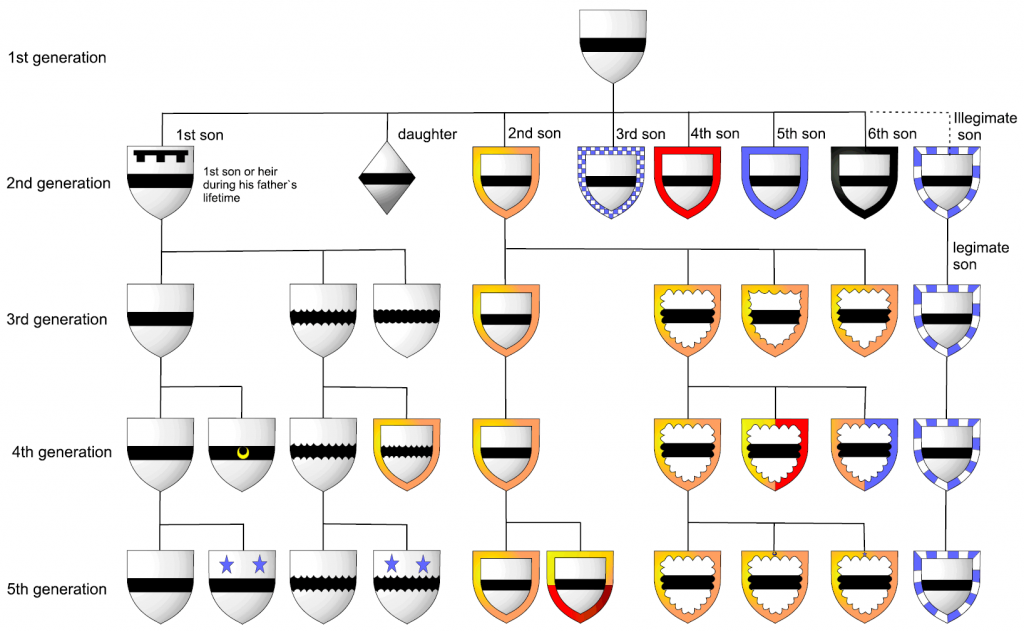
The shield of a common European Coat of Arms, especially of Scottish original will denote the family lineage in the frame of the shield, and/or the markings on the shield. An example of such is below:
Introduction overview to Heraldry in America
Comments are closed.